Neurological diseases R&D trends and breakthrough innovations

This report identifies the latest trends in neurological diseases R&D, surfacing the top assets in development at research institutes and biotech companies around the world.
The trends and breakthroughs in this report were identified by analyzing the engagement of External R&D and BD teams from industry using our online partnering ecosystem to find their next scientific partners.
These insights should provide scientific decision-makers with a roadmap of high-impact opportunities in an evolving and competitive landscape, pinpointing emerging technologies and potential partners to advance neurological diseases R&D.

Download the report
Challenges for neurological diseases R&D
Neurological conditions affect more than 3 billion people globally, with that burden increasing 18% between 1990 and 2021 from ageing populations and increased life expectancy. But momentum has been gathering with the development of more effective treatments. The FDA approved lecanemab in 2023 and donanemab in 2024, the first treatments to actually slow the progression of Alzheimer's rather than managing symptoms. 2024 was also the year that big pharma bet big, investing billions of dollars on getting therapeutics past the blood-brain barrier.
Despite progress, the path from discovery to deployment remains treacherous. The failure rate for CNS drugs is higher than most other therapeutics. Animal models frequently fail to predict human outcomes. And even when breakthrough therapies emerge, particularly with cutting-edge modalities, manufacturing complexities and costs end up limiting economic feasibility and patient access.
With R&D investment on the ascendency, three critical challenges are shaping the approach that academic researchers and industry partners are taking to address neurological diseases:
R&D Challenge #1
Safely crossing the blood-brain barrier
The blood-brain barrier blocks around 98% of small molecules and most biologics from ever reaching neural tissue. But getting through our cognitive fortress isn't enough. Once crossed, therapeutics need to be safe and targeted at scale. Emerging approaches like receptor-mediated platforms and engineered viral vectors show promise, but each brings a set of unknowns about manufacturability and immune response.
R&D Challenge #2
The brain's unforgiving complexity
Unlike many other organs in our bodies, the brain can't afford to make mistakes. Off-target effects that are manageable elsewhere can cause irreversible damage to cognition and motor function. Animal models rarely capture how neurodegenerative diseases play out in humans through pathologies that unfold over decades. This gap between the lab and clinic is why early-stage validation and discovery matters so much.
R&D Challenge #3
Taking new breakthroughs to bedside
Scaling up breakthrough therapies remains incredibly difficult. For example, the gene therapy Zolgensma provides transformative treatment for infants with spinal muscular atrophy. But manufacturing the AAV vectors to carry the genetic payload is complex and expensive. Add in immunogenicity that can limit patients to a single dose, and the challenge becomes clear.
Top neurological diseases innovations
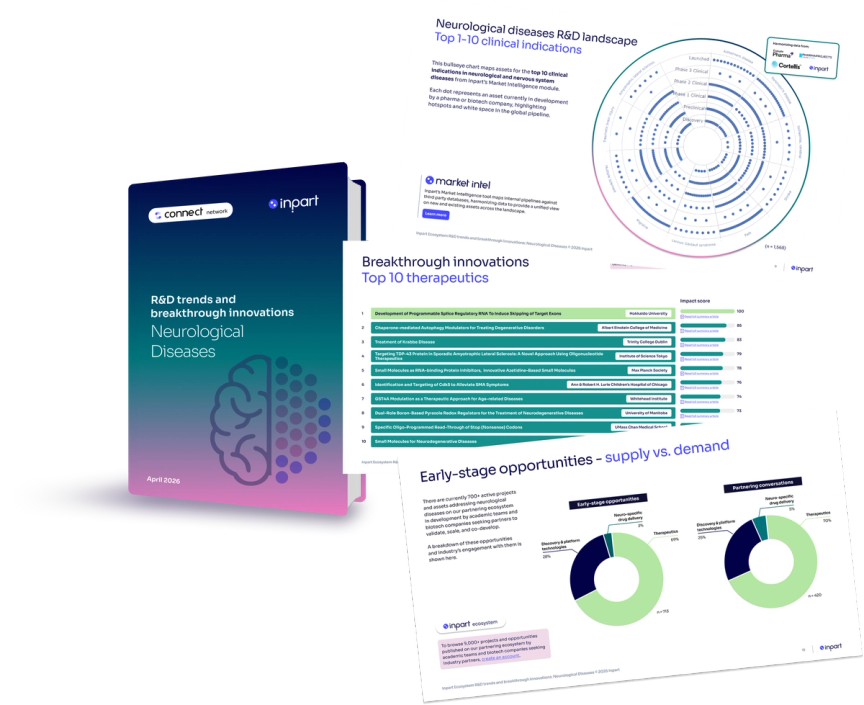
Review the most engaged early-stage research and innovations addressing neurological diseases from our online partnering ecosystem
To read the full summary article of each project and to connect with the team behind it, you will need to join our online partnering ecosystem.
1. Small molecules preventing the buildup of protein aggregates
Chaperone-mediated autophagy (CMA) is a selective quality control pathway responsible for degrading damaged proteins that declines progressively with age. The deterioration of this pathway is implicated in the accumulation of toxic protein aggregates that drive neurodegenerative conditions including Alzheimer's and Parkinson's disease, as well as renal, vascular, and metabolic disorders. Existing approaches to modulate CMA lack the specificity to target it without disrupting other autophagic processes, and most struggle with the pharmacokinetic demands of effective tissue penetration, particularly in the brain.
Researchers at Albert Einstein College of Medicine have developed a suite of chemically defined compounds - spanning benzoxazole derivatives, benzoxazine structures, and modified retinoids - engineered to selectively activate CMA by stabilising the interaction between key regulatory proteins, including RARα and its corepressor. Their compounds demonstrate selective CMA activation, alongside enhanced bioavailability and brain and renal penetration. In vivo validation spans multiple mouse models of tauopathies, Parkinson's disease, renal disorders, and metabolic dysfunction, with additional efficacy shown in primary human haematopoietic stem cells and human renal tissue.
2. Curtailing aberrant mRNA splicing with a high-precision alternative to antisense oligonucleotides
Aberrant mRNA splicing underlies a broad range of genetic and neurodegenerative diseases, making precise splice modulation a high-value therapeutic target. Antisense oligonucleotides (ASOs) are the established tool for this purpose, but carry significant limitations including chemical modification-related toxicity, poor cellular uptake, and short half-lives. CRISPR-based editing offers an alternative, but its irreversibility and vector constraints make it poorly suited to reversible splicing.
Researchers at Hokkaido University and Setsunan University have developed an artificial splicing regulatory RNA (srRNA) derived from the non-coding RNA 4.5SH. Unlike ASOs, which rely on passive hybridisation, this molecule actively recruits splicing-suppressor proteins to the target exon, while an integrated antisense sequence provides gene specificity. Compatible with AAV vectors, LNPs, and plasmid systems, and validated across multiple genes including DMD and MAPT, the platform demonstrated exon-skipping efficiency in DMD models comparable to the approved ASO Viltolarsen at therapeutic concentrations.
3. Fingerprinting a lysosomal aging clock to neurological disease models
Biological clocks have traditionally been defined at the genomic or epigenetic level, but the mechanisms driving cellular decline operate even deeper down to the level of individual organelles. The lysosome, which is responsible for cellular waste clearance, has long been implicated in age-related disease, but no quantifiable biomarker system has yet existed to track its functional decline with age, or to connect that decline to broader disease pathologies.
Researchers working at the Whitehead Institute have developed a high-resolution lysosomal metabolomic profiling platform that combines affinity-tagged lysosome purification with mass spectrometry to generate precise metabolic fingerprints of the lysosome across tissues and species. Using this approach, the researchers have identified specific metabolites that accumulate with age in the brain, heart, muscle, and adipose tissue. Together, these metabolites provide a quantifiable "lysosomal aging clock" that can be applied to preclinical models and human tissue, and used to screen pharmacological, genetic, or nutritional interventions targeting lysosomal health.
4. Detecting tauopathies before significant neuronal loss
Neurological disease with tauopathies - including Alzheimer's, progressive supranuclear palsy, and Huntington's - share a common diagnostic challenge in that substantial neuronal damage will have already occurred by the time symptoms become apparent. Reliable, non-invasive methods to identify disease-specific pathology earlier in the progression of neurological diseases remains an unmet need, particularly tools capable of distinguishing between tauopathy subtypes rather than a generalized dementia signal.
Scientists at Boston Children's Hospital have developed a biomarker-based method for assessing tauopathy risk from biological samples including blood, plasma, serum, CSF, and saliva. By measuring the levels of specific proteins and peptides (for example, elevated NEUS, GUAD, or C1QT3 suggest increased Alzheimer's risk, while changes in P3IP1 or GOLM1 are associated with PSP) and comparing them against reference values using mass spectrometry or ELISA, their method enables disorder-specific risk stratification. Beyond diagnosis, it can also be applied to monitor disease progression and guide treatment decisions.
5. Delivering healthy mitochondrial DNA directly to damaged cells
Mitochondrial DNA (mtDNA) damage is a driver of several age-related neurodegenerative and ocular conditions, including Alzheimer's, Parkinson's, and age-related macular degeneration. Unlike nuclear DNA, mtDNA has proven highly resistant to conventional gene-editing approaches, which struggle with the specificity and delivery challenges unique to the mitochondrial environment. This leaves the underlying causes of dysfunction in these conditions largely unaddressed by therapeutic strategies.
Researchers at the Zucker Institute for Innovation Commercialization have developed ‘TADD’ (Technology for Artificial mtDNA Delivery), a cell-penetrating peptide-based nanoparticle system capable of delivering healthy, full-length mtDNA directly to damaged cells. Unlike gene-editing methods that require expression vectors, TADD replenishes mtDNA without one, addressing the instability and specificity limitations that have constrained previous approaches. Currently in preclinical development across multiple disease models, this platform is being advanced toward clinical application.
6. Using light to unlock RNA therapeutics trapped inside cells
A persistent bottleneck in mRNA and siRNA therapies is endosomal escape - the failure of RNA-bearing lipid nanoparticles (LNPs) to exit the cellular endosomal compartments they become trapped in after uptake. Without escaping into the cytoplasm, the therapeutic cargo degrades before it can act, significantly limiting the efficacy of even well-designed LNP formulations, including those behind approved therapies.
Researchers at the University Health Network's Princess Margaret Cancer Centre have developed novel porphyrin-enriched LNPs and photodynamic chemistry that address this bottleneck using. By incorporating porphyrin lipids into existing LNP formulations, their system ruptures the endosomal membrane on exposure to a near-infrared light pulse, releasing the RNA cargo into the cytoplasm. When applied to the LNP used in Onpattro (Patisiran), the reformulated particle achieved a two-fold increase in RNA release and a four-fold increase in biological effect.
Breakthrough innovations that you won't find anywhere else
Speak with our experts to review your partnering goals and learn how our network, solutions, and tools can help accelerate your research and innovation.